Only What Is Dead Is Transparent
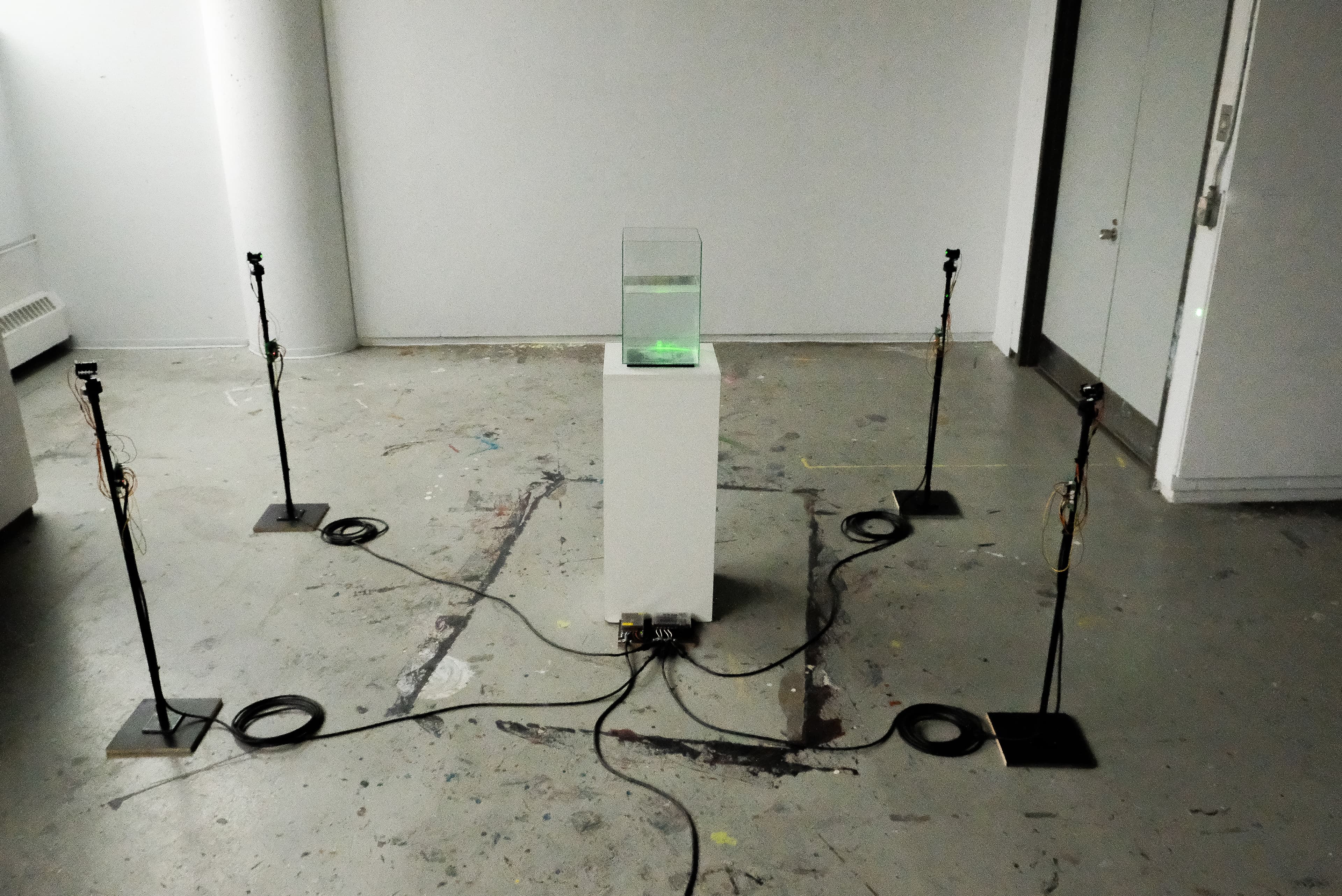
The project offers a visual and contemplative experience, inviting the user to observe the movement of a self-contained lighting system.
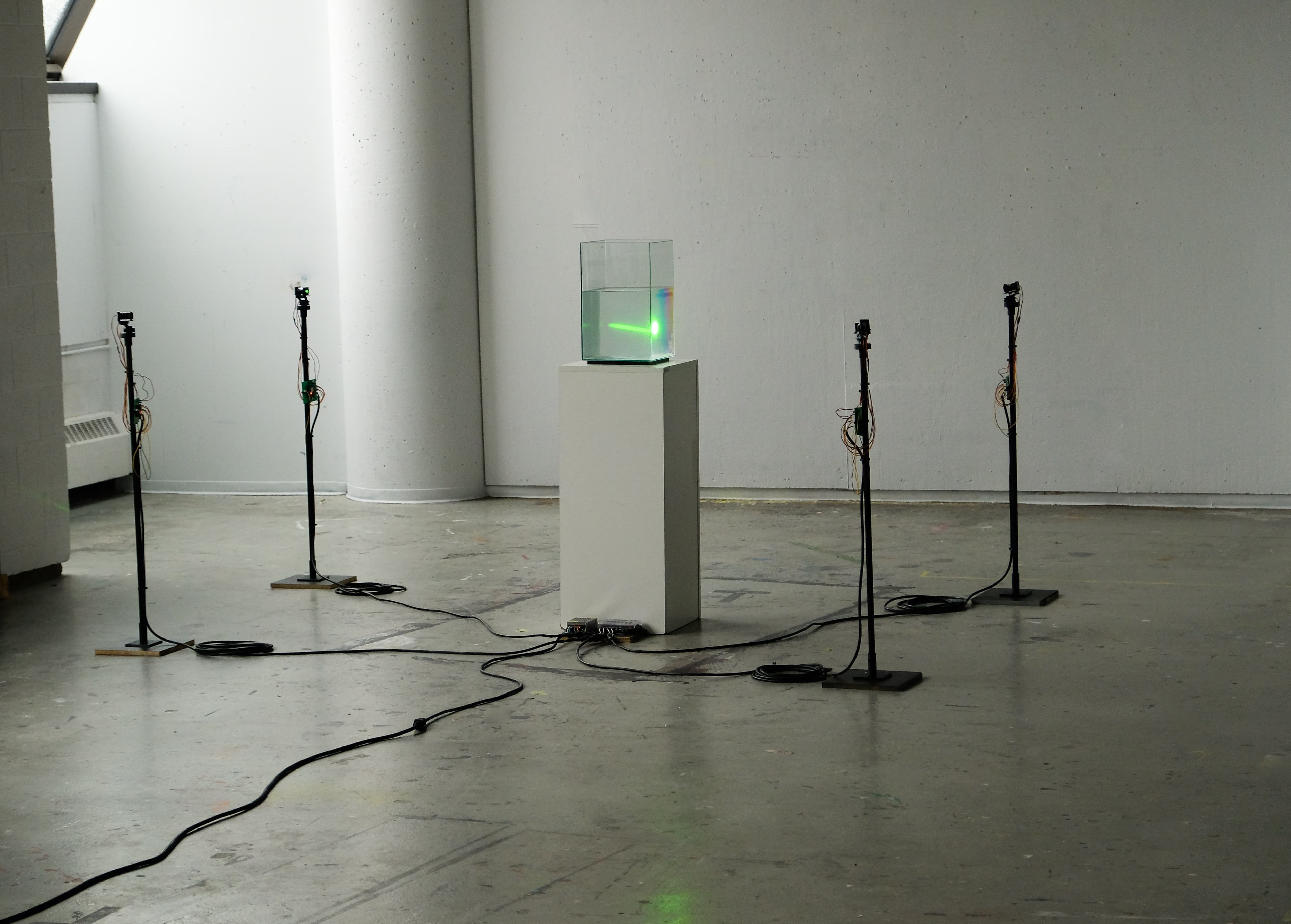
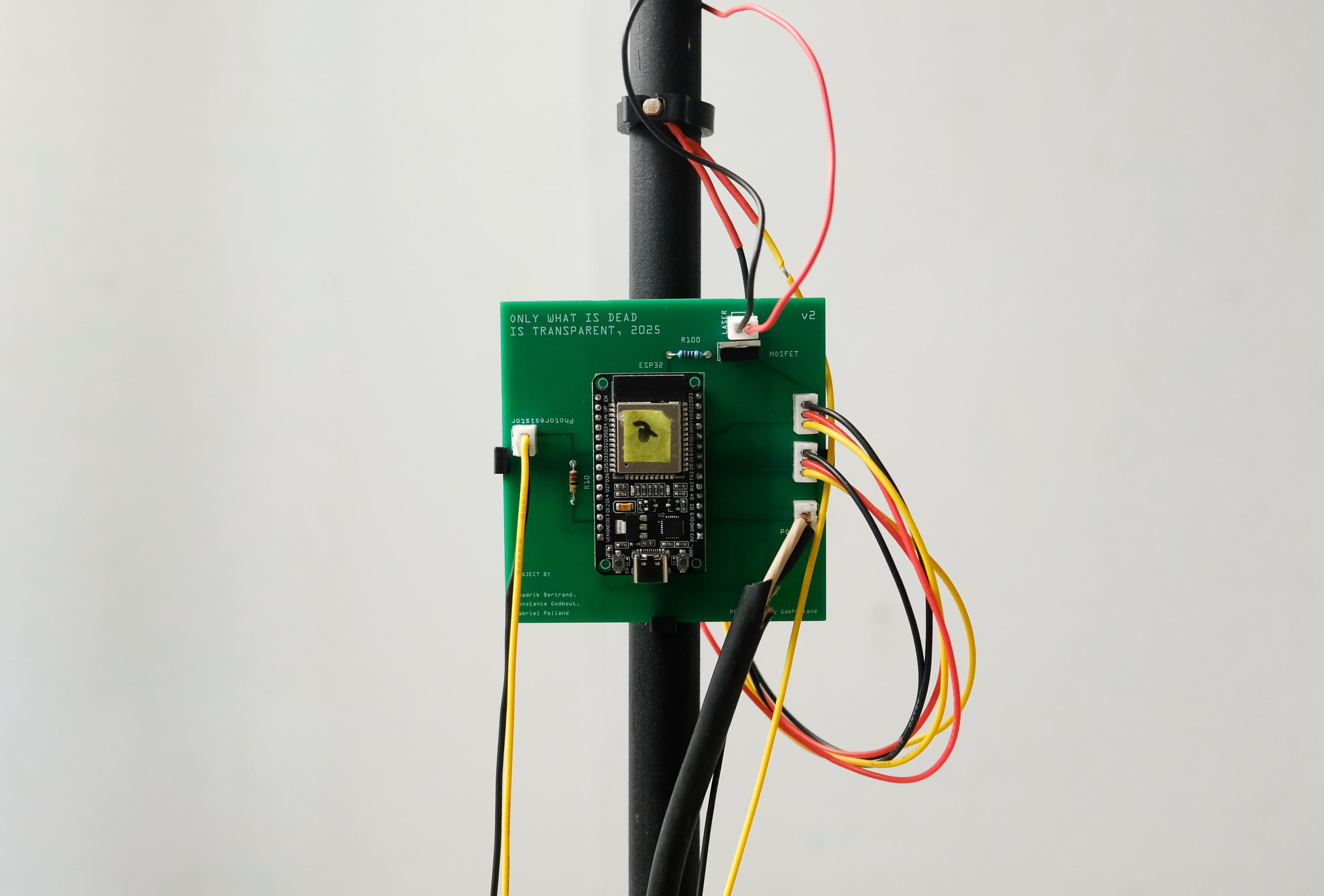
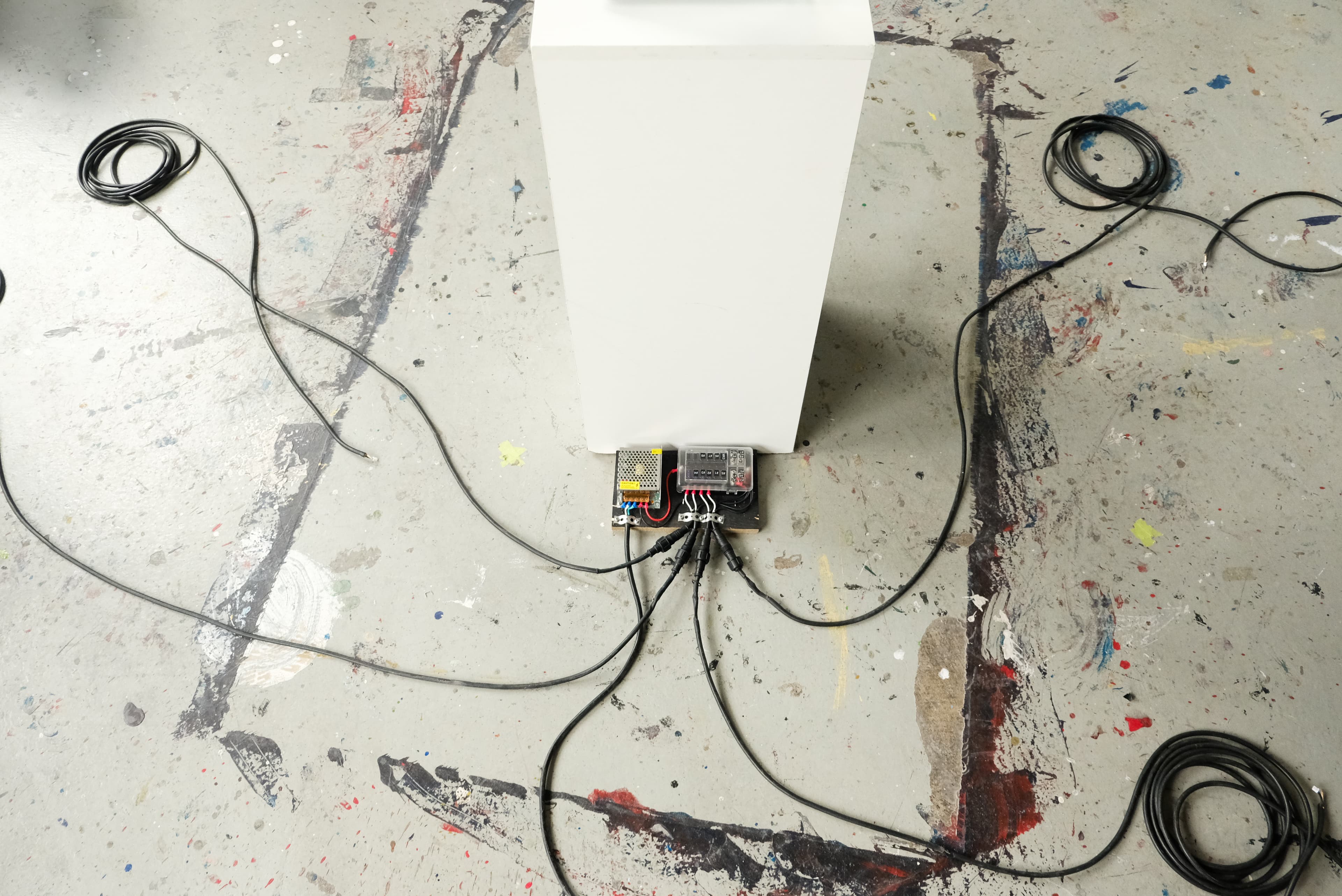
At the center of the room, an aquarium containing salt water acts as both a receptacle and a revealer of light. Four lasers, mounted on metal rods, surround the aquarium and are aimed at it. Their beams, invisible in the air, become perceptible as they pass through the water. Each laser moves randomly horizontally and vertically, with the potential to activate another laser. When one of the photocells detects the beam of another nearby laser, the laser connected to it illuminates in turn, thus creating a cybernetic network of autonomous interactions between the lasers. Each laser has a specific lifespan; it either continues to emit light or it shuts down.
The artwork's aesthetic draws inspiration from both the natural phenomena of light reflection and diffusion and from control mechanisms such as the panopticon. Referencing the writings of Byung-Chul Han (The Transparency Society) and Michel Foucault (Discipline and Punish), the installation questions the violent potential of transparency and the disappearance of secrecy in societies. The installation explores the tension between visibility and power, between revelation and disappearance. In his book The Transparency Society, Han describes transparency as a neoliberal mechanism where everything must be made visible, measurable, and communicable—a logic that transforms freedom into control and communication into surveillance. In this work, light becomes a metaphor for this constraint. The atmosphere seeks to evoke the fragile balance between freedom and surveillance, life and extinction, transparency and saturation.
Design, Programming & Logistics: Chadrik Bertrand
Design & Artistic Direction: Constance Godbout
Design & Electronics: Gabriel Pelland